Monday, April 4, 2011

Chasing Winter


A couple of weeks ago our friend Dustin came up from Oklahoma for a visit.  Dustin is also a birder and had never been to Michigan before.  Now Michigan in late March is in a transitional period, kind of before most of the interesting migrants start moving through as spring progresses but a bit late to spot some of the more interesting wintering species.  So even as spring was taking a firm grasp of lower Michigan and warmer temperatures and melting snow was the rule in Lansing, we decided to chase winter and headed to the frozen north of the U.P.

Dustin had never birded anywhere much farther north than Oklahoma/Colorado, so a wide variety of boreal/artic species could be lifers for him.  So even though it was a relatively "poor" bird winter in Michigan (very few northern owls, not a great winter finch year either) we thought we could get him a few lifers.  The first night we stayed in Sault Ste. Marie, so we could hit up the farm country south of town that usually holds so many of the cool winter species that the U.P. is known for.  We started off pretty slow and I was beginning to worry that most of the winter stuff was gone. Soon however we found a big flock of Common Redpolls, which was a lifer for Dustin.  Amazingly almost the very first first redpoll I put my binoculars on turned out to be a really nice Hoary Redpoll, also a lifer for Dustin.  I assured Dustin that this isn't the usual way it goes (and indeed of the 40-50 other redpolls in the flock, that was the only Hoary).  Almost immediately after this we saw a really beautiful dark morph Rough-legged Hawk one of three we would see in rapid succession.  We nexted drove to Dafter to look for some reported Bohemian Waxwings but ended up dipping out on that species but we did repeat the large redpoll flock with 1 hoary in it performance.  A mile or so outside Dafter we saw a large flock of 40-50 snow buntings, another lifer for Dustin.

We next checked out the Dafter Dump but the gate was locked and it was a Saturday so we couldn't get in.  We scoped the huge flock of gulls from the road but had a hard time seeing anything, though we did finally pull out one Glaucous Gull.  We next drove over to Hulbert Bog in the off chance that we could find a Boreal Chickadee, which has apparently been harder to do there lately.  Despite about a 2 mile walk and chumming for chickadees with townhouse crackers we only managed in working up the large local flock of black-capped chickadees.  We did however get Dustin two more lifers in Ruffed Grouse and Red Crossbill.

We drove up to Whitefish Point but not much happnening there birdwise.  We decided to stay the night in Paradise so we drove over to the Tahquamenon Falls State Park, where we had an excellent whitefish dinner and some locally crafted beer at the Tahquamenon Brewing Company.  We headed back to Whitefish Point to see if the owl banders were having any luck.  We stayed just long enough to watch the banders bring in a nice little female Saw-whet owl, which was fun to see.

The next day we had one main goal.  To get Nikki and Dustin their life Snowy Owl.  Though they might be more common and easy to see than the other rare northern owls, you have to respect the utter awesomeness of a giant white owl.  So anyway we started driving the roads around Rudyard, almost getting stuck in the wet/frozen roads a couple of different times  but we were rewarded with this...

One of my all time favorite birds!

After watching it for a bit a Rough-legged Hawk flew down and made a couple passes at the Snowy Owl.  On the third pass the Snowy Owl flew up and took a swipe at the Rough-leg with its talons!  Quite the winter bird show!  Reluctantly we had to head back to the Lower Peninsula so Nikki and I could go back to work and Dustin could catch his plane back to Stillwater.  Dustin ended up with something like 6 lifers, he will have to return during a better owl winter for more U.P. goodies!


Tuesday, March 8, 2011

An injured plover, an endangered species conundrum

Late last fall we began to hear news in the office about a piping plover that was hanging out unusually late along the shores of southern Lake Michigan.  We first heard about this plover in October when some local birders in Berrien County, MI spotted the bird and noticed that it appeared to be missing its left leg.  Within a few days Tim Baerwald, an active birder in southwest Michigan actually got good enough photos to read the band combination from the metal band that was on the remaining leg.  From this band we learned that this was a male plover that had nested last summer at Sleeping Bear Dunes National Lakeshore in northern Lake Michigan.  The bird was successful in fledging two chicks but was involved in a predation incident involving another one of his chicks.  Soon afterword monitors noticed that he would not place any weight on his left leg, leading to speculation that it may have been injured defending his chicks.  As with all banded birds, their are occassional accidents involving caught bands or other band related injuries that sometimes lead to leg injuries of this kind, but we don't have any direct evidence of that in this case.

Anyway, at first we weren't unduly alarmed.  Other plovers had stayed later in the past and we have other individual plovers missing a foot that have survived and successfully bred for multiple years.  However as October progressed into November and we continued getting reports that the plover was still being seen in and around Warren Dunes St. Park we began to worry.  The bird had not molted out of its alternate plumage, leading to speculation that it was in no condition to attempt the migration to the primary wintering area for Great Lakes Piping Plovers, the southern Atlantic coast of South Carolina, Georgia and Florida.  Additionally it was beginning to get colder and colder and we were becoming increasingly concerned the bird would not be able to find enough food to survive.  Finally around veteran's day we decided it was time to attempt a rescue.  Getting the proper permits ready for the Lincoln Park Zoo in Chicago (who have done piping plover rehab in the past) and arranging for them to take the bird in took a couple days.  When I was finally ready to drive the 2:30 hours down to Berrien County, the plover suddenly disappeared.  It was not seen again for several days, then put in an appearence but then disappeared again.  This time it was not seen for over a week and we had begun to think the bird had either died or attempted to migrate.

Finally the day after Thanksgiving (when there were only a couple other people in the office because of the holiday) I got an e-mail that the plover had been spotted Thankgiving evening (making it the latest record ever of Piping Plover in Michigan).  As there was supposed to be a winter storm brewing we decided it was now or let the plover die, so we decided to attempt to capture the injured plover.  So another biologist who was with our office at the time, Sarah Warner, and I gathered up my mist nets and other gear and drove down to Berrien County.  The very helpful birders who had been spending a lot of their free time monitoring this bird were waiting to help us in the capture attempt.

We were greeted by below zero winds coming off of Lake Michigan but soon spotted the plover, hiding behind the only bit of cover on the beach.

Photo by Charles McKelvy
Due to the supposed condition of the bird, we had speculated that it might be very easy to capture.  Leading me to even bring along a butterfly net, which seems pretty silly now.  It turned out that the plover, though somewhat emaciated, still had his full powers of flight and capture was not easy.

Charles McKelvy, who writies for a local northern Indiana, southwest Michigan newspaper called "The Beacher" tells the whole story here in good style...

http://www.thebeacher.com/pdf/2011/BeacherFeb03.pdf  just scroll down for the whole story, with the added benefit for readers of a goofy picture of me holding a butterfly net (professional wildlife biologist indeed, lol)

Long story short, after much work and a colloborate effort by all the assembled capture team we were able to guide the plover into the mist net.


Me getting the plover out of the mist net, photo by Charles McKelvy

We delivered him to a bird keeper from the Lincoln Park Zoo for continued transportation.  Though as mentioned he was pretty underweight and likely would not have survived in the wild much longer; the plover made a fairly rapid recovery and is currently on display at the zoo.  The main question is what happens to him now?  The humanitarian perhaps says the rescue in and of itself was worth it as it saved the bird from starving or freezing to death on the shores of Lake Michigan.  The conservationist may chime in that he is now a useful education bird, great public outreach to teach zoo visitors about the ongoing conservation work done on the endangered Great Lakes Piping Plover and other imperiled Great Lakes critters.  But what about something more?  Captive breeding perhaps, as the zoo also has a female plover from the Great Lakes population?  Or releasing him back into the wild this spring?  Each choice presents different issues, legal and ethical to ponder.  Captive breeding (as opposed to captive rearing of eggs and chicks taken from the wild after being abandoned which we already do) would change the whole nature of the program, and is very expensive.  And what of the ethical decision to release a crippled bird back into the wild?  Things we continue to ponder, but in the meantime if you are in the Chicago area stop by and say hello to our little plover friend!

Monday, March 7, 2011

Great Lakes Piping Plovers in Canada


As the population of Great Lakes Piping Plover has grown in the last decade they have returned to some former parts of their breeding range that had been abandoned for decades.  This includes some areas in Canada, particularly along the Ontario side of Lake Huron.  The above photo is a bird that nested at Tawas Point St. Park in Michigan last year.  Although this bird was nesting on the Michigan side of the lake, because of its band combination we know it was born on the Canadian side in Ontario.

Recently I was interviewed by a Canadian journalist for an article he was working on about Piping Plovers breeding in the Canadian Great Lakes.  Here is a link to the article

http://onnaturemagazine.com/beach-birds.html

Tuesday, November 9, 2010

Fool Hen


On a recent trip back to the U.P. Nikki and I visited one of our favorite places, Whitefish Point Bird Observatory in Chippewa County, perhaps the best location in the midwest to view waterbird and hawk migration.  Though the waterbird migration was a bit pedestrian on the two days we were there (Sabine's gull and a juvenile parasitic (probably) jaeger but very low numbers overall) we did get great looks at one of my favorite species the above spruce grouse or "Fool Hen" as it locally known.  This species which earned its nickname for sometimes being ubsurdly tame when approached, resides in coniferous boreal forests across much of Canada and Alaska, but barely reaches the lower 48 in places like the U.P., northern Minnesota and northern New England.

Though locally common in spots in the U.P. it can be very difficult to pin down at any given time.  In fact when I was in high school this was a major nemesis bird for me, as I dipped out time and time again even though it occurs in areas right around my families hunting camp.  In fact check out my old website (keep in mind I created this back in the olden days of the interwebs when I was in high school so its a bit lacking um lets say lacking) www.angelfire.com/mi/upbirding for details of my then obsession of finding spruce grouse in the U.P.!  My hometown library had a copy of Bill Robinson's great book "Fool Hen: The Spruce Grouse on the Yellow Dog Plains" which chronicles his painstaking research on this species in one of my favorite (and now sadly threated) parts of the U.P.  Still one of my favorite books about the practice of field ornithology, "Fool Hen" only made me want to spend more time exploring the jack pine barrens and spruce bog edges where these birds can be found.


After I started working bird field jobs in some of the best parts of the U.P., I got to see lots and lots of spruce grouse and watch them displaying and see hens with chicks, but after a four and a half year stint in Oklahoma, I was pretty excited to see my old friend the fool hen again!  Here are some more photos.


Wednesday, October 13, 2010

My new job - Great Lakes Piping Plovers!


I was hired this summer to work for the U.S. Fish and Wildlife Ecological Services Office in East Lansing, MI.  One of my primary duties is to act as the field coordinator for the endangered Great Lakes population of the Piping Plover.

Many people are unaware that there are three distinct Piping Plover breeding populations, one along the Atlantic Coast, one along the rivers and prairie potholes of the northern Great Plains, and the one that nests along pristine sandy beaches in the Great Lakes.

Both the Atlantic Coast and Great Plains populations are listed as threated by the U.S. Fish and Wildlife Service and number less than 2000 pairs.  By far the most imperiled is the Great Lakes population which is listed as endangered (on the wintering grounds on the Gulf and southern Atlantic coasts, the whole of the population is considered threatened).

Historically, Great Lakes Piping Plovers were estimated to number perhaps 600-800 pairs and breed across most of the Great Lakes basin.  However, habitat loss and nest disturbance and predation on the breeding grounds had reduced the Great Lakes Piping Plover population to under 20 pairs by the 1980s; almost all on isolated beaches in northern Michigan.

Since then a mix of intense conservation efforts by the U.S. Fish and Wildlife Service, state agencies and countless volunteers, as well as lowering Great Lakes water levels (which provides more beach habitat for the birds) has resulted in a slow but steady increase in the Piping Plover population.  Last year a high of 71 pairs was reported across the Great Lakes basin, breeding in areas where breeding hadn't occurred in decades such as parts of Canada, Wisconsin and even Illinois.

However the Great Lakes Piping Plover continues its precarious life on the endangered species list and only intense monitoring, nest protection and other conservation activities have likely allowed it to persist at all.  Now the Gulf oil spill presents new hazards for the Piping Plover on its wintering ground (luckily the bulk of the Great Lakes population seems to winter along the atlantic coasts of Georgia and Florida). 

Much work remains to be done but I am sure I and the many other members of the Great Lakes Piping Plover conservation team will try our best to help make sure the ringing cry of PEEP-LOH!! continues to ring out from beautiful Great Lakes beaches!


A Great Lakes Piping Plover broods its nest inside a nest enclusure in Michigan.

Hummingbirds of Southeast Arizona

As the leaves begin to fall here in Michigan and cold and cloudy weather starts to set in, I thought it was time for a bit of warmth, energy and color!  So without further build-up here are a collection of hummingbird photos from last spring's trip to southeast Arizona; mostly from Miller Canyon in the Huachucas and various spots in the Chiracahuas.


Probably my favorite of the Arizona Hummingbirds is the Magnificent (formerly Rivoli's).  A beautiful hummingbird that makes its home in the sky islands of Arizona and the Sierras in Mexico.


Black-chinned Hummingbirds were common at all the different areas of southeast Arizona that we visited.


A rare treat was this Berylline Hummingbird, one of the rarest of the regular Mexican hummingbird strays in Arizona.


It was even collecting nesting material!


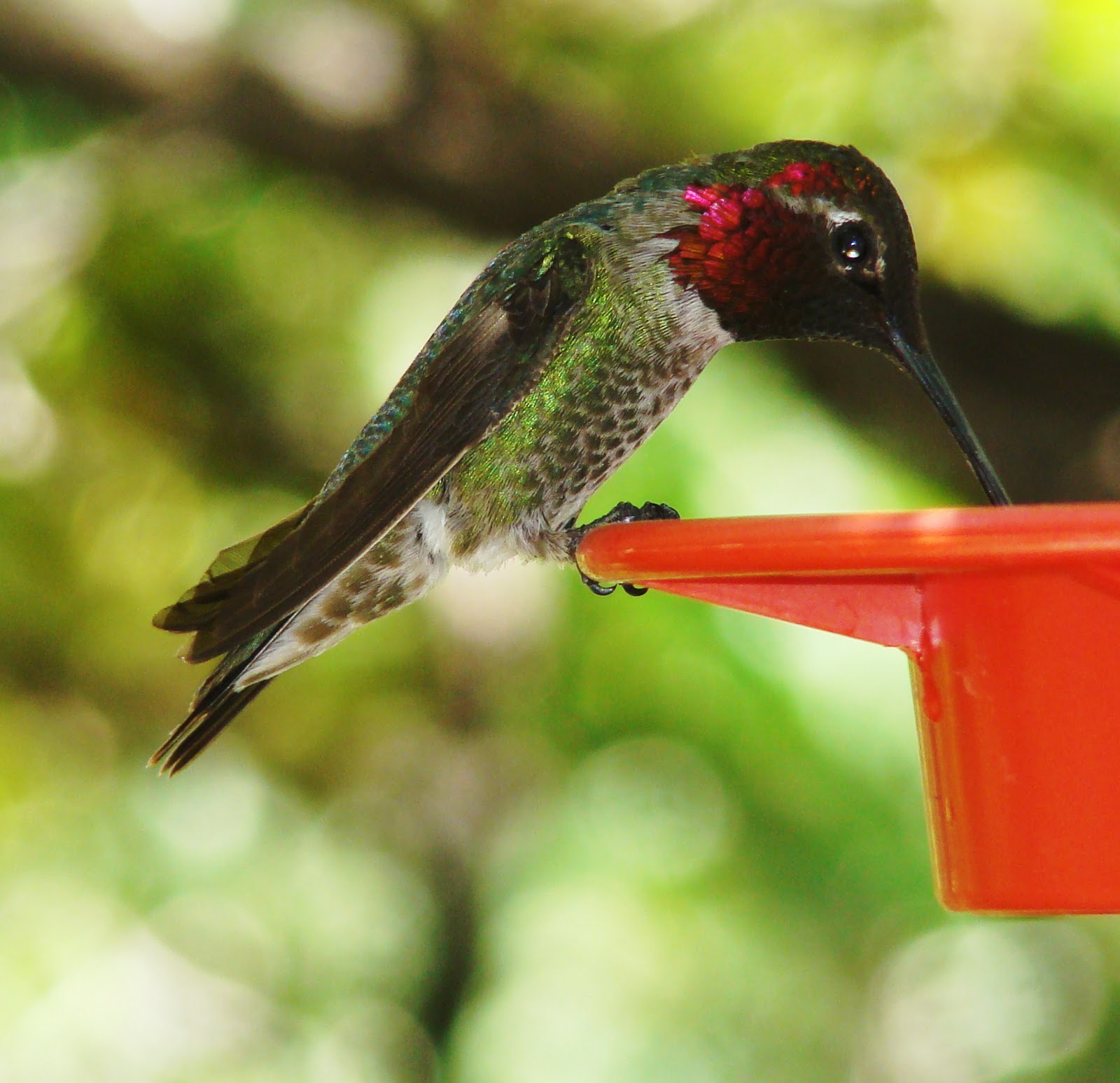
Anna's Hummingbirds are always a beautiful feast for the eyes.


White-eared Hummingbirds are amongst the most wanted species for birders visiting southeast Arizona.


A regular behemoth by hummingbird standards, the Blue-throated Hummingbird is the largest species of hummingbird that occurs north of Mexico.


Another southwestern beauty is the broad-billed hummingbird.


... and we finish off our hummingbird party with this cool shot of a tiny broad-billed hummingbird in front of a massive Giant Saguaro!

Monday, August 30, 2010

Arizona - continued

Some photos of wildlife taken in and around Sunny Flat Campground in Cave Creek Canyon, AZ.


Arizona Woodpeckers were common in the campground

and were easy to photograph

The local gang of Mexican Jays spent a lot of time begging for food


Yellow-eyed Juncos were very common at higher elevations

Gambel's Quail were common in the desert lowlands below Portal

Nikki believes she has a special power to draw-in flycatchers, like this Cordilleran Flycatcher


Blue-throated Hummingbirds are one of the many special Hummingbirds of southeastern Arizona